
Are We There Yet?

Are we there yet? I remember pestering my father with that question over and over during car trips to visit my grandparents. However, that might not be accurate because my Dad probably wouldn’t have tolerated that behavior for long. False memories from TV shows, Hollywood movies, or commercials can mislead those who ignore the Stoics’ advice about self-awareness. As Marcus Aurelius reminds us in Meditations: “You have power over your mind — not outside events. Realize this, and you will find strength.”
Strength is a valuable trait today amid a flood of fake news, uninformed opinion, and blatant lies that define the coverage of our Punitive Campaign against Iran. For 47 years, I’ve maintained that the Islamic Republic of Iran delenda est. I have taken great pleasure in watching the theocratic authoritarians ruling Iran being dismantled. Yet, like you, I have no idea how this campaign is progressing, which I see as a positive sign.
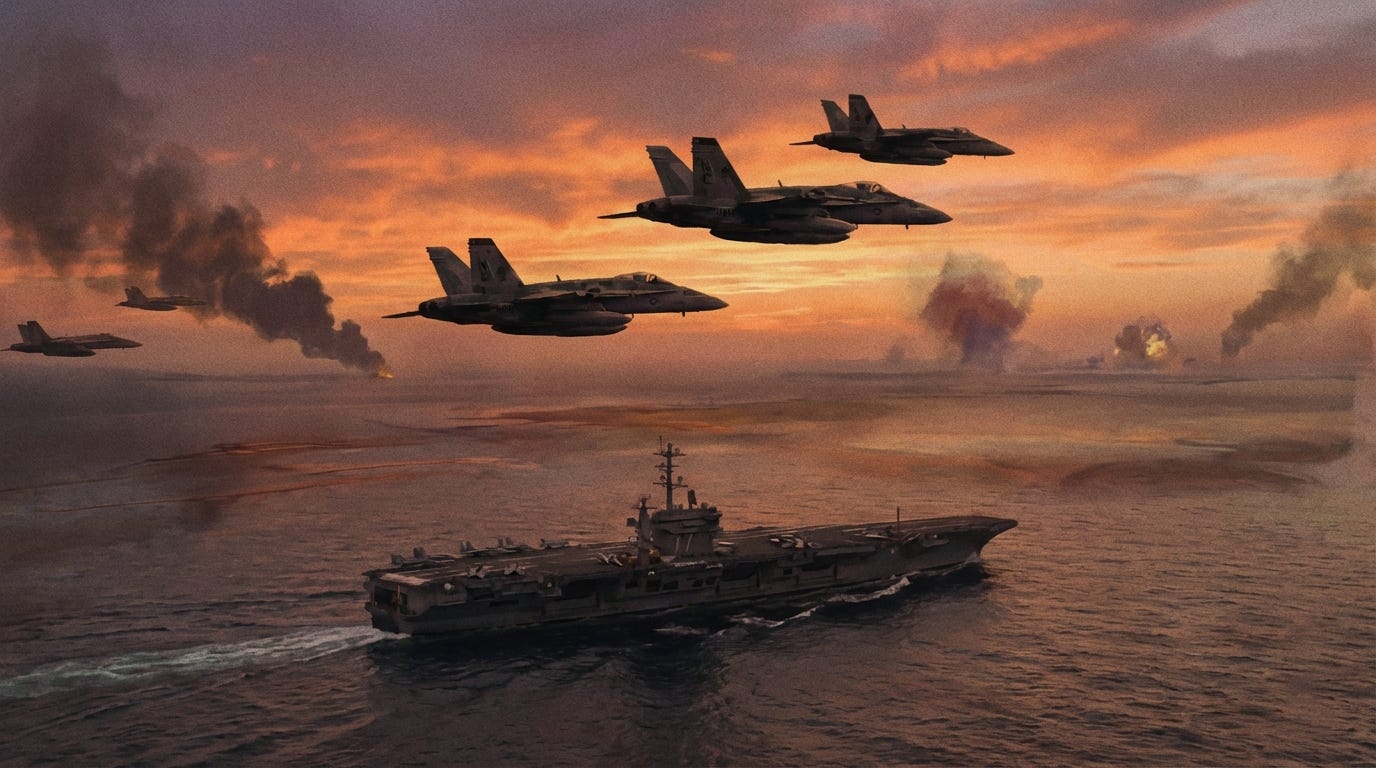
Pete Hegseth, who is despised by the credential experts who gave us fifty years of abject foreign policy and military failure, has built a strong record of military victories. His disciplined Department of War doesn’t leak, stays on message, and supplies the media with a steady stream of metrics on what it has achieved, providing plenty of information that means little. That is how we are supposed to fight, especially when the media and the Democratic Party do everything they can to ensure we lose.
The left opposes everything Trump does, so their reaction to Operation Epic Fury is to be expected. However, it’s clear that the Iranian Punitive Campaign has, to some degree, split the right. Most of President Trump’s supporters trust him to see this through to a successful outcome. The biggest drop in support comes from the Gen Xers and Millennials, who fought in the Afghanistan and Iraq wars. Those humiliating failures are still fresh in their minds, leading them to believe Iran might end up the same way.
The other drop is support comes from former MAGA stalwarts like Tucker Carlson and Megyn Kelly, who have turned into virulent anti-Semites convinced that the little land of Israel controls the government of the United States. The idea is, on its face, preposterous. Israel, like the United States, is a divided country 48% conservative, 48% progressive, and 2% crazy. They have enough problems trying to hold a ruling coalition together, so how the hell could they be secretly controlling our government when they can barely control their own government?
Iran is not going to end like Afghanistan or Iraq because we are not going to commit massive ground forces to a regime change or nation-building mission. Yet there are ground forces heading toward Iran. On the 14th of March, the 31st Marine Expeditionary Unit (Special Operations Capable) started steaming toward the Gulf of Oman from their home ports in Japan. It will take them about two weeks to get on station, putting them in play just days before President Trump meets with President Xi in Beijing.
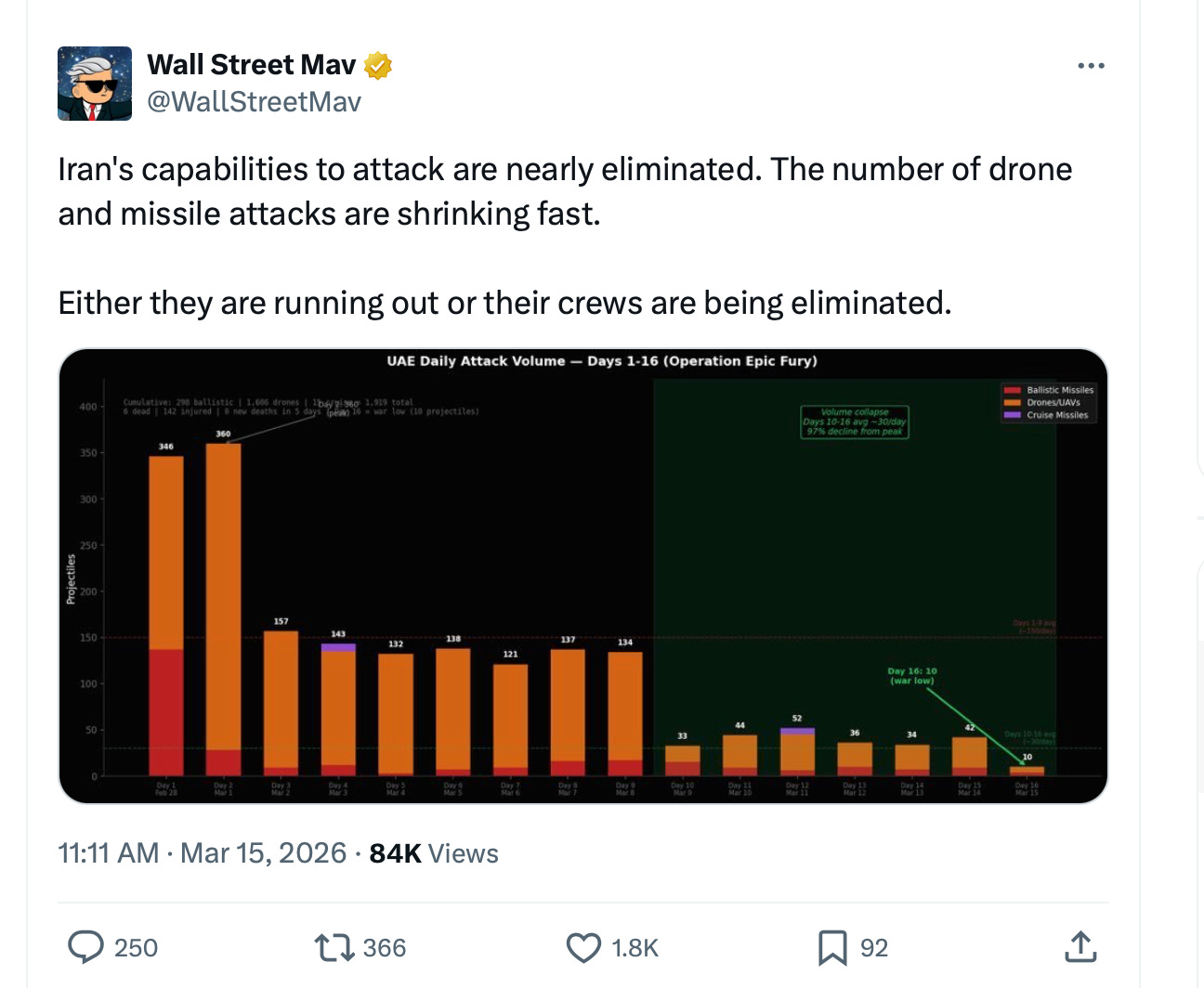
They could be given the mission of taking and fortifying Kargh Island to secure the infrastructure through which 90% of Iran’s petroleum exports flow. That would require the elimination of Iran’s missile and drone capability, which, given the perceptible drop in Iranian attacks, is possible. The Marines also bring robust VBSS (Visit, Board, Search, and Seizure) and TRAP (Tactical Recovery of Aircraft and Personnel) capabilities that the CENTCOM commander could put to good use.
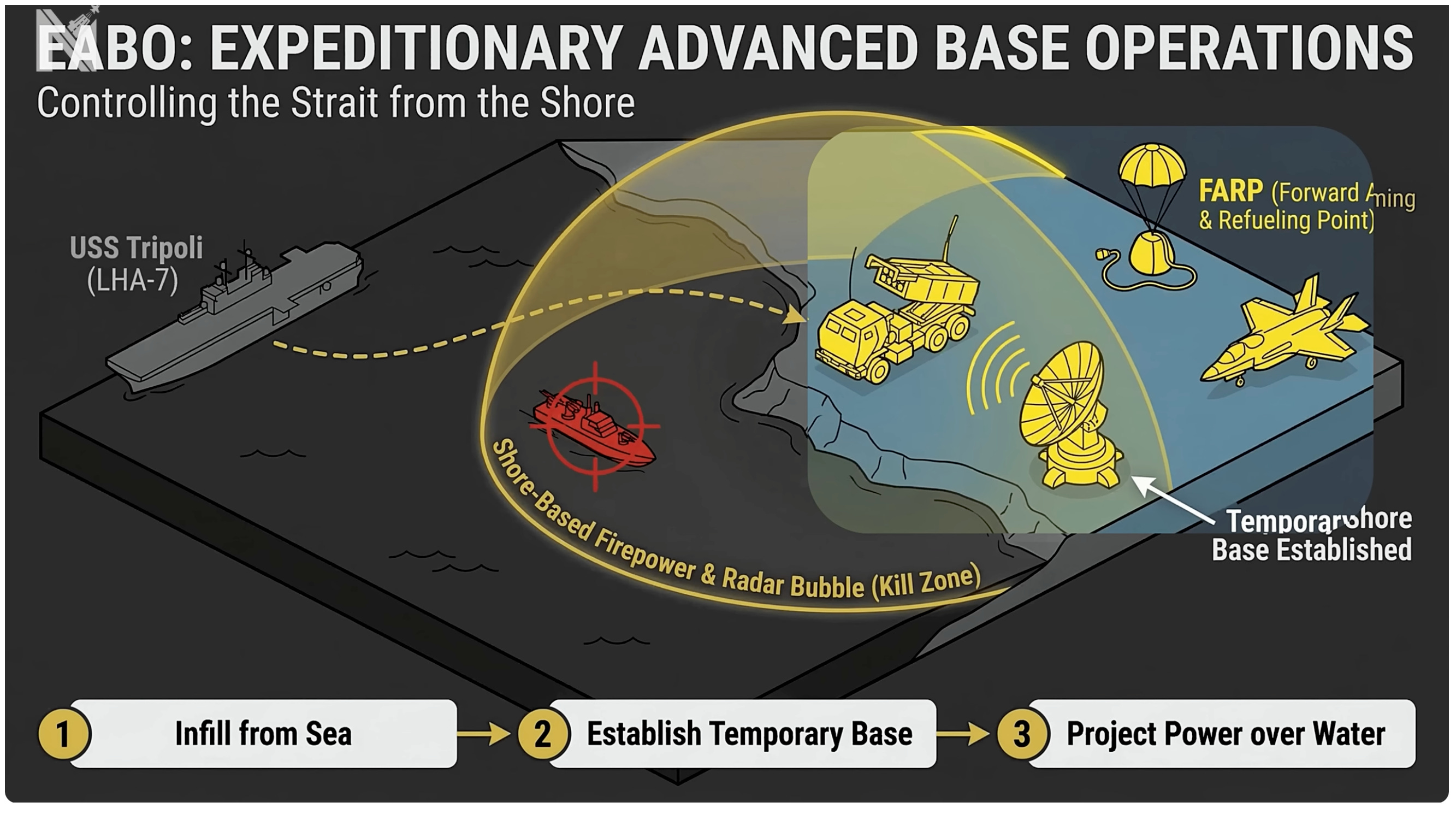
The USS Tripoli LHA 7 is similar to the old rust bucket USS Tripoli LPH 10, on which I deployed during the first MEU (SOC) WESTPAC in 1987. It has no well deck. The old World War II era LPH ships had no well deck because they were designed to be escort carriers. Modern helicopter carriers were designed with well decks to facilitate the ship-to-shore flow of troops and logistics. The first two America-class ships, LHA 6, USS America, and LHA 7, USS Tripoli, were built without well decks until Congress mandated that the remaining LHA-class ships be redesigned to include well decks. I’m not sure why they were designed that way, but, until now, they have been considered expensive mistakes.
The non-well deck design doubles the hangar bay space, significantly increases aviation maintenance facilities, adds a full surgical hospital, and increases jet fuel storage. It can accommodate 20 F-35Bs, which is almost half of a super carrier air wing, and it costs 3.5 billion, compared to 13 billion for a super carrier. That makes it, in the cold calculus of war, more expendable than a carrier. Thus, it can operate much closer to the Straits of Hormuz, which closes the huge gaps in air coverage over the strait.
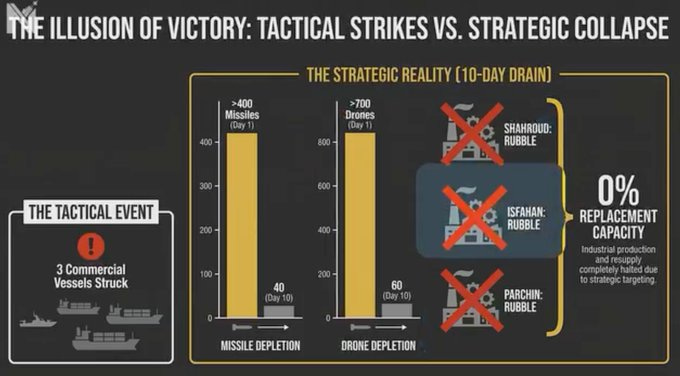
Iran bet that we did not have enough interceptors to stop every drone or enough missiles to sink every speedboat. They were right. At the tactical level. But we aren’t fighting at the tactical level; we’re fighting at the industrial level. Iran believed cheap weapons would always defeat expensive ones. At the tactical level, that was true. But we are not firing Tomahawks at fast boats. Instead, we bolted a $20,000 GPS guidance kit onto a $4,000 bomb and dropped it on the factories that built every weapon Iran owns. A $25,000 package erased decades of investment. That is the payoff for stand-in versus stand-off bombing.
USS Lincoln and USS Ford are approximatly 4oo nautical miles away from the Hormuz staight. The USS Tripoli could operate within 100 nautical miles, reducing transit time and increasing coverage to fight the only threat Iran has left: speedboats. But speedboats that have no missiles to shoot are fishing boats with machine guns, and those can’t close the straits of Hormuz.
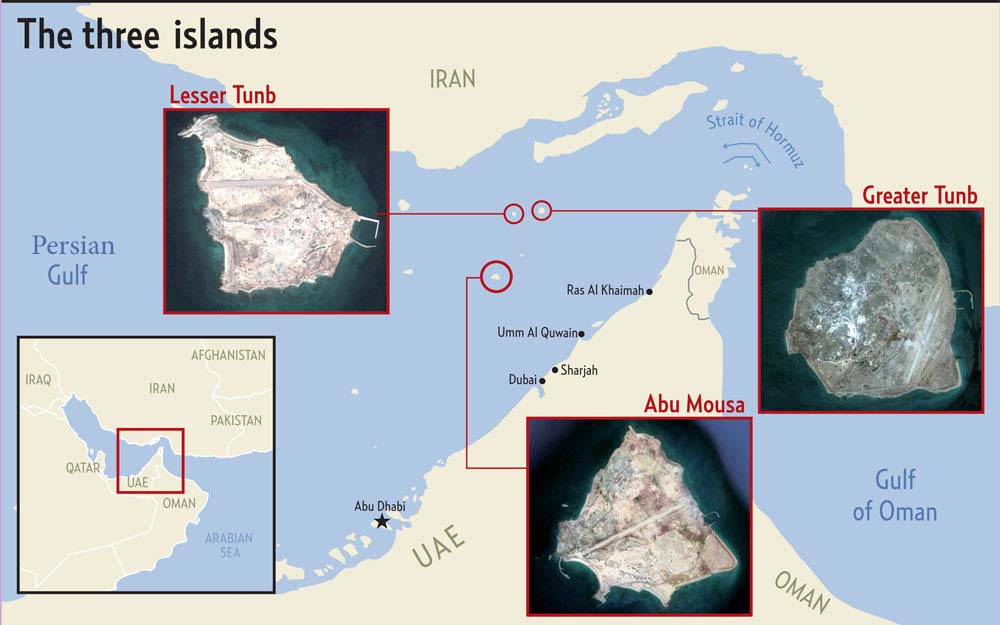
Three fortified islands—Abu Musa, Greater Tumb, and Lesser Tumb—sit directly inside the Hormuz shipping corridor. Iran has fortified them with anti-ship missile batteries, coastal radar, artillery positions, and IRGC garrisons. These are fixed platforms capable of launching ordnance into the shipping lanes at close range. Even after Epic Fury’s air campaign, any remaining capability on these islands threatens every vessel passing through the corridor. Marines from the Tripoli can insert via vertical envelopment, flying over the minefields Iran has spent decades preparing in the waters around their static defenses. They don’t need to garrison these islands—just kill all the IRGC troops while destroying the missile launchers and radar installations, as they did during Operation Praying Mantis in 1988. Killing people and breaking things is what the Marine Corps does best.
There is an additional capability the 31st MEU brings to this fight: the ability to establish multiple HIMARS (the M142 High Mobility Artillery Rocket System) positions with FARP (forward arming and refueling) sites on abandoned islands or sparsely populated shorelines inside the Hormuz Straits. This is how you can control the six miles of open water inside the straits without jeopardizing expensive surface combatants. The 31st MEU often deploys with a battery of HIMARS (six launchers), and that battery can operate in a distributed manner with 3 sections of 2 launchers operating independently. That would establish a tight shore-based kill zone inside the Hormuz Straits that Iran could not counter with their emimic ground forces.
It is clear that the United States will not deploy significant ground troops to Iran. Without boots on the ground, regime change is doubtful. We can deduce that any more talk from President Trump about regime change or unconditional surrender is him introducing friction into the Iranian regime’s OODA loop. Trump is the only modern President who can personally employ that level of psyops against his enemies. Israel has also stated unequivocally that regime change is not one of its objectives.
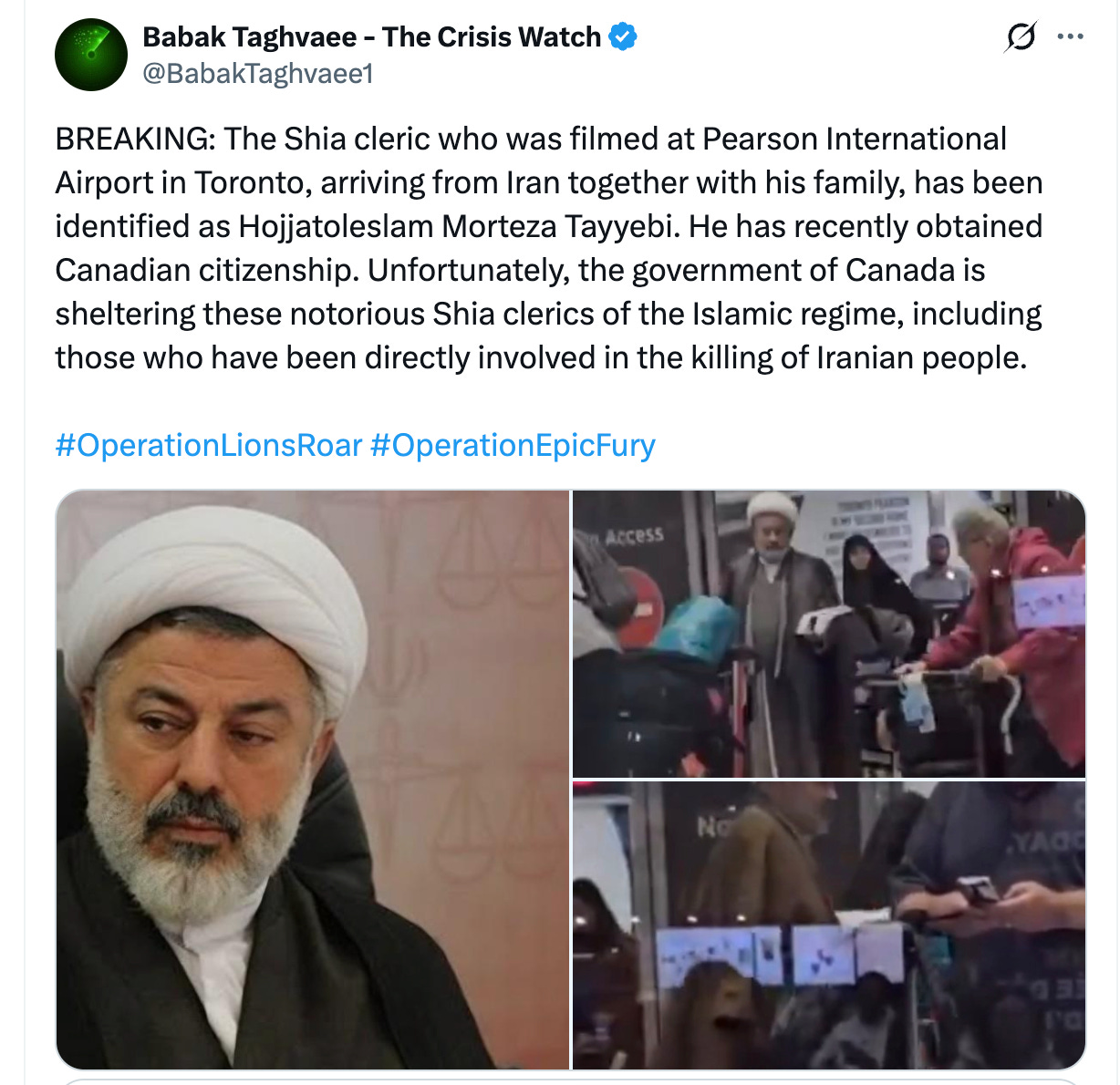
It appears Iranian rats are jumping ship to Canada. A member of Canada’s Parliament, Melissa Lantsman, wrote an Op-Ed claiming there were hundreds of IRGC agents fleeing to Canada, where the Carney government welcomes them with open arms. Why welcome those same terrorists who are shooting at your troops in the Middle East? Muh racism, of course, plus the Orange Bad Man is beating them like a drum, so they must be defended. Despite Canada’s stupidity in accepting these dirtbags, it is a good sign pointing towards a positive ending to our punitive campaign.
Doran Kempel, former Deputy Commander of Israel’s elite Sayeret Matkal special forces, contends key IRGC generals—frustrated and cornered—are primed to defect and turn against the regime. That would be the most positive outcome we can hope for. The alternative is to turn Iran into Iraq by comprehensively destroying its infrastructure to the point they can never again hope to develop an organic nuclear or ballistic missile capability. That is not what we want to do, but it could be what we have to do if the mullahs insist on holding onto power despite the strong objections of over 80% of the population. This would be much easier if the citizens of Iran were protected by the Second Amendment.
Tim,
After 32 years of attending every Navy and Marine Corps post-Graduate school,, as well as AWC ans JFSC, I have this creeping recollection of Amphibious Operations in the Jask AOR, that leads me to believe we may be looking to open another front in theater- based on having that scenarionused for training in several of those schools. I would guess that is part of some standing OPLAN that I was never read into in my CENTCOM/SOCCENT tours. It makes strategic sense, but I don't have enough operational insight to know. Interested in the opinions of your readers...
Thank you for this well-written article. It gave me a much clearer sense of where the finish line might be—and it brought back vivid memories of my father. He was a gunnery officer aboard an LST, steaming toward Japan when the two atomic bombs were dropped. I’d give anything to have him here now, offering his hard-earned perspective on what comes next in this conflict.